Executive search fees: how search firms charge and what to ask before you sign
In this article
The main fee models in executive search, what drives the final amount, and the contract questions that prevent surprises.
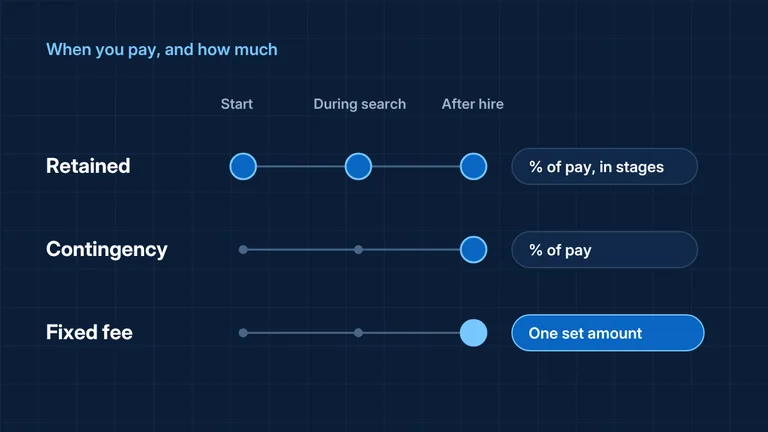
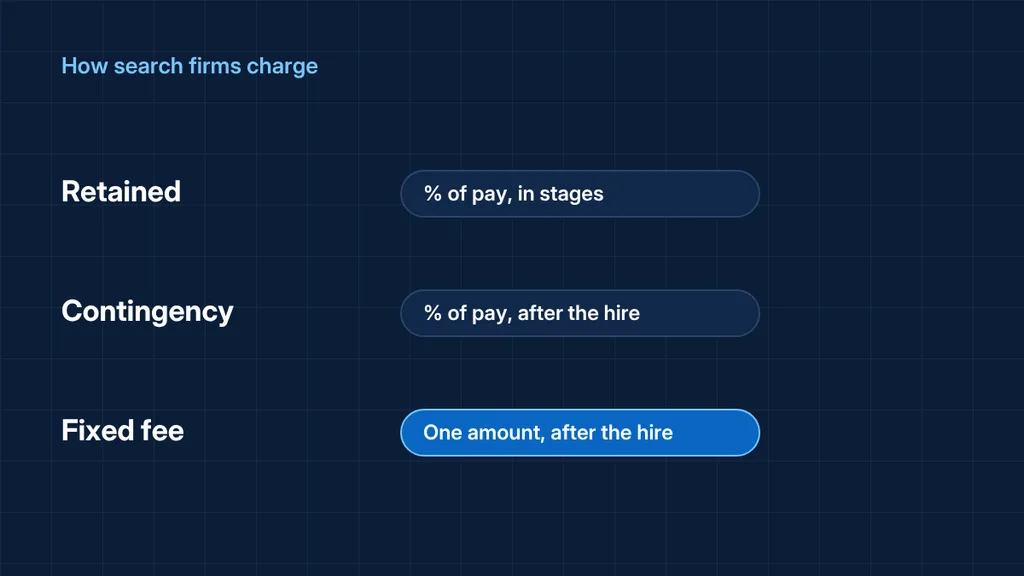
Most executive search firms charge a percentage of the new hire's first-year pay. In retained search the fee is split into stages and part of it is paid before the hire; in contingency search you pay only after the hire. Some firms offer a fixed fee: one amount agreed before the search starts. The percentage itself is only half of the cost. What counts as "pay", when each payment is due and what happens if you do not hire matter just as much.
Reading time: about 3 min
Contents
In short
- Percentage fees grow with the salary of the person you hire.
- Retained: paid in stages, usually starting before the hire.
- Contingency: paid only after a hire, often with several agencies competing.
- Fixed fee: one amount agreed upfront that does not change with the final offer.
- Always check what counts as pay, the payment dates and the guarantee.
The three fee models
Percentage of pay, retained. The firm works on your role exclusively. The fee is a percentage of first-year pay, split into stages, for example at the start, at the shortlist and at the hire. Early stages are usually not refunded if you stop the search.
Percentage of pay, contingency. You pay only if you hire someone the recruiter introduced. The fee is usually a percentage of pay, and several agencies may work on the role at once.
Fixed fee. One amount, agreed before the search starts, often paid after the hire. It does not grow if the final offer is higher, so you know the cost upfront.
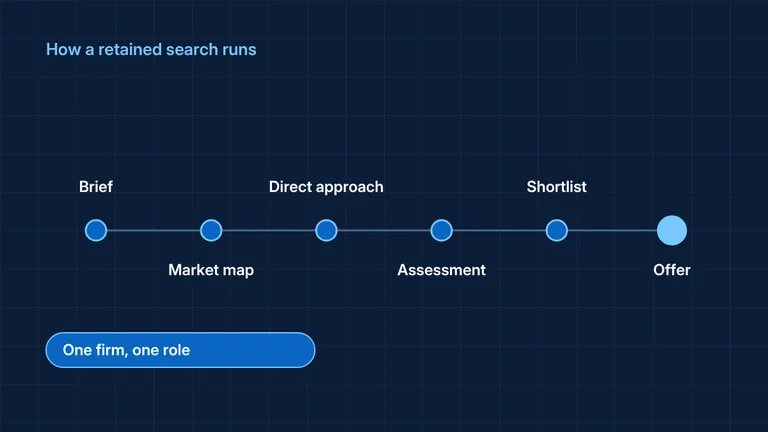
The trade-offs between the first two are explained in retained vs contingency search, and the retained model step by step in retained executive search.
What counts as "first-year pay"
Two offers with the same base salary can lead to very different fees. Check in the contract which parts of pay are included:
- base salary only, or base plus target bonus;
- sign-on bonus and relocation support;
- equity, options or long-term incentives;
- car, allowances and other benefits.
Ask the firm to show the calculation on a sample offer. If the final package changes during negotiation, the fee usually changes with it.
What drives the cost of a search
- How rare the profile is. The fewer people who can do the job, the longer the market map and outreach.
- Seniority. Senior hires need more assessment, references and stakeholder interviews.
- Location and languages. A role open to several countries means a larger market to map.
- Confidentiality. A search that cannot be advertised relies only on direct approach. See confidential search.
- Your own process. Slow feedback and changing requirements make any search longer and more expensive.
Fee questions for the contract
- What exactly do we pay, when, and what happens to each payment if we do not hire?
- Is the fee a percentage of pay or a fixed amount? Which parts of pay count?
- Are expenses such as advertising, travel or assessments included, or billed separately?
- What happens if the new hire leaves early? How long is the guarantee, and what exactly does it cover?
Questions about exclusivity, the team and the method are in how to choose an executive search firm.
Hidden costs that are not on the invoice
The fee is not the only cost of a search. A slow or failed search costs management time, delayed projects and sometimes a second search. When you compare offers, compare how each firm plans to reach the right people, not only the percentage.
How Talentholo charges
Our recommended model is a fixed fee: one amount agreed before we start, paid after the hire, not a percentage of salary. You know what the search will cost, and we have no reason to favour the highest-paid candidate. A success fee as a percentage of pay is also available. You get a concrete number in the first conversation. Most searches carry a guarantee of three to six months, agreed before the search starts. See our executive search service.
FAQ
How much do executive search firms charge?
Most charge a percentage of the new hire's first-year pay. Some charge a fixed fee agreed before the search. Ask each firm for its exact percentage or amount and which parts of pay count.
When do you pay an executive search firm?
In retained search, in stages, usually starting when the search begins. In contingency and many fixed-fee searches, after the hire.
Are executive search fees refundable?
Paid retained stages usually are not. Many firms offer a guarantee if the hire leaves early. Check the exact terms in the contract.
Is a fixed fee cheaper than a percentage?
Not always, but it is predictable. The amount does not grow with the final offer, so you know the cost before the search starts.
Want a concrete number for your hire?
Tell us about the role and you get the fee in the first conversation.
Book a free 15-min consultation