
Confidential recruitment: how to hire for a role you cannot advertise
In this article
When a search needs to stay confidential, who inside your company should know, what candidates hear at each stage, and the places where these searches usually leak.
Confidential recruitment is a search for a role that you cannot advertise, because the company, the role or the reason for hiring must stay private for now. A search partner approaches people directly and describes the role without naming you. Candidates learn who the company is only later, once they are interested and have agreed to keep it to themselves. Done well, it lets you hire without unsettling your team, your clients or the person who is leaving.
Reading time: about 5 min
Contents
In short
- No job ad: candidates are approached directly, with the role described but the company not named.
- Keep the group inside your company small and agree in writing who knows.
- Reveal the company name step by step, only to people who are interested and have agreed to keep it private.
- Leaks usually come from inside: calendars, shared documents and one well-meant conversation.
When a search needs to be confidential
- A replacement. The person in the role is leaving, or will be asked to leave, and the team does not know yet.
- A new role that signals a change. A first country manager, a new product line or a reorganisation that is not public.
- A hire competitors should not see. Recruiting a leader from a market you have not entered yet tells everyone where you are going.
- A senior hire before a funding round or a sale. The news could affect investors, clients or the price.
If none of these apply, an open search is simpler and usually faster, because you can name the company from the first message.
Who needs to know
Write down the names of everyone inside your company who knows about the search, and keep the list as short as you can. Usually that is:
- the person who makes the final decision,
- the future manager of the new hire, if that is a different person,
- one person from HR or legal who prepares the contract,
- the search partner.
Agree how you talk about it internally. A neutral project name in calendars and email titles helps, because "Interview: Head of Sales" in a shared calendar is a common way these searches come out.
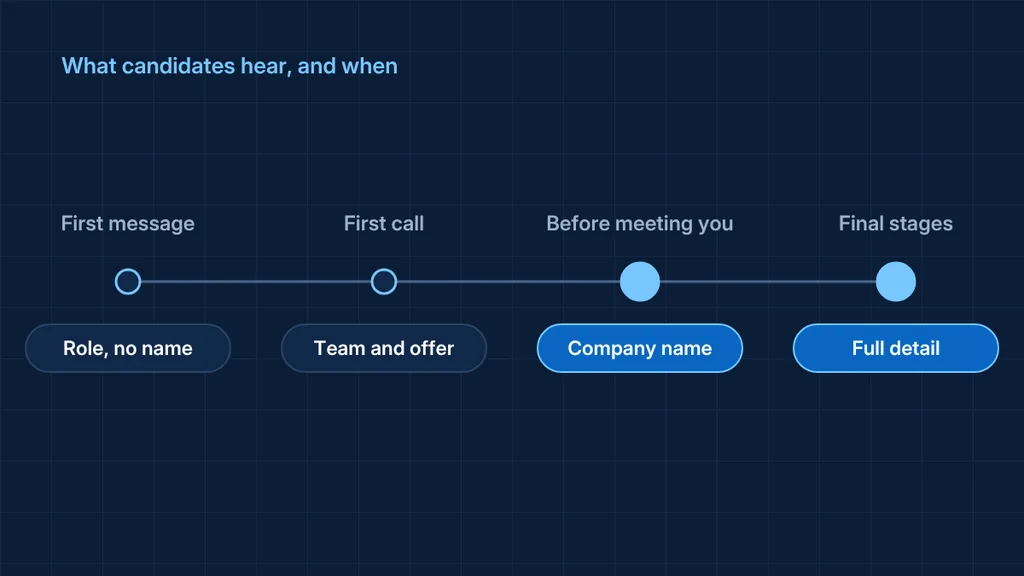
What candidates hear, and when
A confidential search still has to interest people who are not looking. The trick is to give enough detail to make the role attractive without making the company easy to guess.
| Stage | What the candidate hears | What the candidate agrees to |
|---|---|---|
| First message | The role, the scope, the size and type of company, the location and the reason it is open, without the name | Nothing yet |
| First call | More about the team, the challenges and the offer range | To keep the conversation private |
| Before meeting you | The company name and who they will meet | A short confidentiality agreement, if you need one |
| Final stages | Full detail, including why the role is confidential | The usual offer terms |
Be careful with the description in the first message. In a small market, "a 300-person software company in one mid-sized city that sells to banks" can point to one name. Describe the role in more detail and the company in less.
Where confidential searches leak
- Calendars and meeting rooms. Interviews booked under the real job title, or candidates waiting at reception.
- Shared documents. A job description or an org chart in a folder that more people can open than you think.
- Your own team's network. Asking a colleague "do you know a good CFO?" is often the moment a search stops being private.
- Too many agencies. Every firm that hears about the role is another set of people who can talk. Use one search partner.
- Candidates who know each other. In a niche market, people talk. Approach them in a sensible order and do not reveal the company name too early.
If you are replacing someone
A replacement search is the hardest kind, because the person in the role may find out before you are ready. Before you start, decide what happens if they do: who talks to them, and what you say. Agree with your lawyer or HR what you can and cannot do under their contract and local employment law. And plan the handover: the best hire still needs time with the team, and that is easier when the change is announced well.
For how to agree the role itself before a leadership search starts, see what to align before hiring a leadership role.
How Talentholo runs confidential searches
We run direct searches for specialist and leadership roles, for companies in the EU, the US and Germany, wherever the role is. We also run confidential searches, such as a replacement that is not public yet. The founders, Marcin Cieszyński and Renata Chmiel, are responsible for the brief, the search strategy, the assessment and the recommendations. Our team supports part of the research, outreach and first screening. Read more about our executive search or how to choose between retained and contingency search.
FAQ
What is confidential recruitment?
Confidential recruitment, also called confidential recruiting or a confidential search, is a search for a role that is not advertised, where candidates are approached directly and the company is named only once they are interested and have agreed to keep the conversation private.
Why would a company hire confidentially?
Usually to replace someone who does not know yet, to prepare a change that is not public, or to keep competitors from seeing where the company is going.
Do candidates sign an NDA?
Sometimes. A short confidentiality agreement before the company is named is common for senior roles. For other roles, a clear spoken agreement with the search partner is often enough.
Can I run a confidential search with several agencies?
It is possible, but every extra firm increases the number of people who know. Many companies use one search partner for confidential roles.
Need to hire for a role you cannot advertise?
Tell us about the role in a short, private call and we will say how we would approach it.
Book a free 15-min consultation