
Retained vs contingency search: how to choose, and when a fixed fee fits
In this article
How retained and contingency search work, what each costs you in money and risk, which one suits which hire, and a third option: a fixed fee paid after the hire.
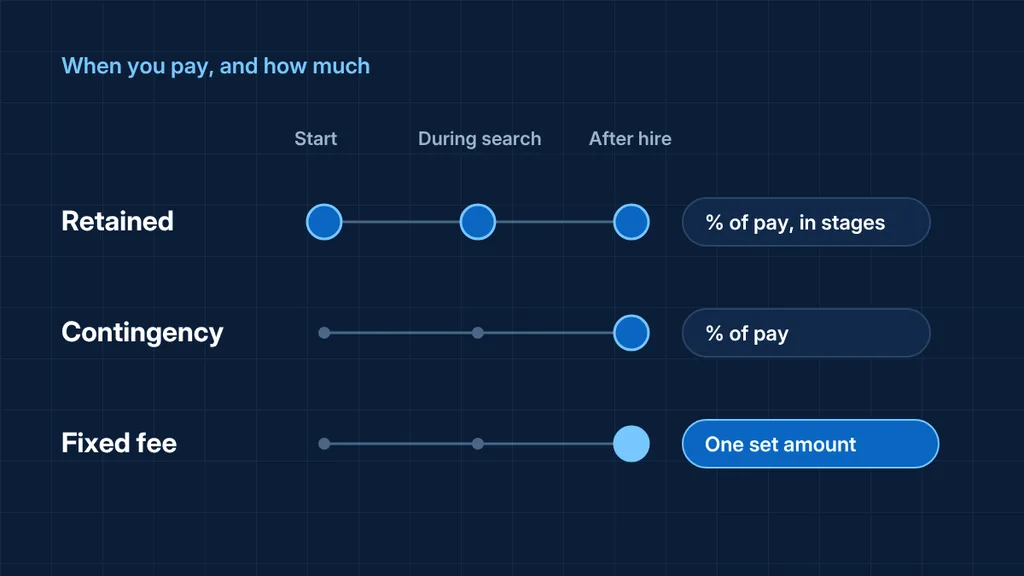
In a contingency search, you pay only if you hire someone the recruiter introduced. In a retained search, you pay a search firm in stages, part of it before anyone is hired, for exclusive and deeper work on one role. Contingency suits roles where good people are easy to reach. Retained suits rare, senior or confidential roles. A fixed fee agreed upfront and paid after the hire sits between the two.
Reading time: about 5 min
Contents
In short
- Contingency: you pay only when you hire, and several firms may work on the same role.
- Retained: one firm works on the role exclusively and is paid in stages, usually starting before the hire.
- Most contingency and retained fees are a percentage of the new hire's pay, so the cost grows with the salary.
- A fixed fee is one amount agreed before the search starts and does not change with the salary.
How each model works
Contingency search. The recruiter sends you candidates and gets paid only if you hire one of them. You often brief several agencies at once, and they compete to send CVs first. The fee is usually a percentage of the person's first-year pay.
Retained search. You choose one search firm and commit to it for the role. The firm maps the market, approaches people who are not looking, and assesses them in depth. You pay in stages, for example at the start, at the shortlist and at the hire. Part of the fee is due even if you do not hire anyone in the end.
Some firms also offer exclusive or "engaged" search: exclusive like retained, with a smaller first payment. The names vary from firm to firm, so read what each stage means in the contract, not the label.
Cost and risk side by side
| Contingency | Retained | |
|---|---|---|
| When you pay | Only after a hire | In stages, usually starting before the hire |
| How the fee is set | Usually a percentage of first-year pay | Usually a percentage of first-year pay, split into stages |
| Exclusivity | Rarely; several agencies may work on the role | Yes, one firm |
| Who carries the risk | The recruiter: no hire, no fee | You: part of the fee is paid even without a hire |
| How deep the work goes | Often people who are already active or in the agency's database | Market mapping and direct approach to people who are not looking |
| Confidentiality | Harder, because the role is shared widely | Easier, because one firm controls who hears about it |
One thing both models share: when the fee is a percentage of pay, the recruiter earns more if the salary is higher. That does not mean anyone acts in bad faith, but it is worth knowing when you negotiate an offer.
Which model for which hire
- Common profile, many active candidates: contingency, or your own job ad, is usually enough.
- Several similar roles at once: contingency or an embedded recruiter who works inside your team.
- Rare profile, few people who fit and most of them not looking: retained or a fixed-fee search, because someone has to map the market and approach people one by one.
- Senior or leadership role: retained or a fixed-fee search, because assessment takes more time than finding CVs.
- Confidential search, such as a replacement that is not public yet: one firm only, never a role shared with several agencies.
- A previous search failed: first find out why. Sometimes the agency failed. Sometimes the profile did not exist at the budget, location or timeline. A new search will not fix the second problem.
The third option: a fixed fee paid after the hire
Many companies want the depth of a retained search without paying before they see results, and without a fee that grows with the salary. A fixed-fee search is built for that.
- One amount, agreed before the search starts. You know the cost of the hire before you begin.
- Not a percentage of salary. The fee stays the same whether the final offer is higher or lower, so the recruiter has no reason to push for the highest-paid candidate.
- Paid after the hire. As with contingency, you pay when the role is filled.
- One firm, working the role in depth. As with retained, the search includes market mapping and direct approach.
It does not suit every case. When you want to test a new partner on a role that is easy to fill, a classic success fee can be a simpler start.
Questions to ask before you sign
- What exactly do we pay, when, and what happens to the money if we do not hire?
- Is the fee a percentage of pay or a fixed amount? Which parts of pay count: base, bonus, equity?
- Is the search exclusive? Will you work on the role alone, or alongside other agencies?
- What happens if the new hire leaves early? How long is the guarantee, and how is it written in the contract?
For questions about how a partner works, who does the research and how candidates are assessed, see recruitment agency or executive search.
How Talentholo charges
We run direct searches for specialist and leadership roles, for companies in the EU, the US and Germany, wherever the role is. Our recommended model is a fixed fee: one amount agreed before we start, paid after the hire, not a percentage of salary. A success fee as a percentage of pay is also available. We offer a guarantee of three to six months, agreed before the search starts. The founders, Marcin Cieszyński and Renata Chmiel, are responsible for the brief, the search strategy, the assessment and the recommendations. Our team supports part of the research, outreach and first screening. Read more about our executive search in Poland or compare a recruitment agency and executive search.
FAQ
What is the difference between retained and contingency search?
In contingency search you pay only if you hire a candidate the recruiter introduced, and several agencies may work on the role. In retained search one firm works on the role exclusively and is paid in stages, usually starting before the hire.
Is retained search worth the money?
It is worth it when the profile is rare, the role is senior or the search must stay confidential. For common roles with many active candidates, contingency or your own job ad is usually enough.
What is a fixed-fee search?
A search where you agree one amount before the work starts and pay it after the hire. The fee is not a percentage of salary, so it does not change with the final offer.
Can I use several agencies for one role?
Yes, on contingency terms. It can bring CVs faster, but the same people may be approached several times and the role is hard to keep confidential.
Not sure which model fits your hire?
Tell us about the role and we will say which model makes sense, and what it would cost.
Book a free 15-min consultation