In-house recruiter vs agency: what each costs and when to use which
In this article
What an in-house recruiter really costs, what an agency costs, how to compare the two for your own numbers, where RPO fits, and which roles need a different route.
An in-house recruiter is a fixed cost: you pay a salary, tools and ads every month, whether you hire or not. An agency is a variable cost: you pay a fee for each hire. In-house usually wins when you hire often for similar roles. An agency usually wins when you hire rarely, or when the role is one your own team cannot reach.
Reading time: about 6 min
Contents
In short
- An in-house recruiter costs the same in a month with ten hires and a month with none.
- An agency charges a fee per hire. With a contingency agency you pay nothing until someone is hired.
- Divide the yearly cost of in-house recruitment by the hires it makes, and compare that with the agency fee.
- RPO is an outsourced recruitment team, usually for steady or high volumes.
- For a rare or senior role, reach matters more than the price per hire.
What an in-house recruiter really costs
The salary is the visible part. In the US, the median pay for human resources specialists, a group that includes recruiters, was $75,940 a year in May 2025, according to the US Bureau of Labor Statistics (page read 11 November 2026). Pay in your country and for your level of recruiter will differ, so use a real offer if you have one.
On top of the salary, count:
- Employer costs. Taxes, benefits and the cost of a desk and a laptop.
- Tools. An applicant tracking system (ATS), a LinkedIn Recruiter seat and any sourcing tools.
- Job ads. Paid listings and promoted posts.
- Time to get going. A new recruiter needs time to learn your roles, your managers and your market before the first hires land.
- Your managers' time. Briefs, interviews and feedback. You pay this with any model, but with in-house you also manage the recruiter.
All of this runs every month, including the months when you are not hiring.
What an agency costs
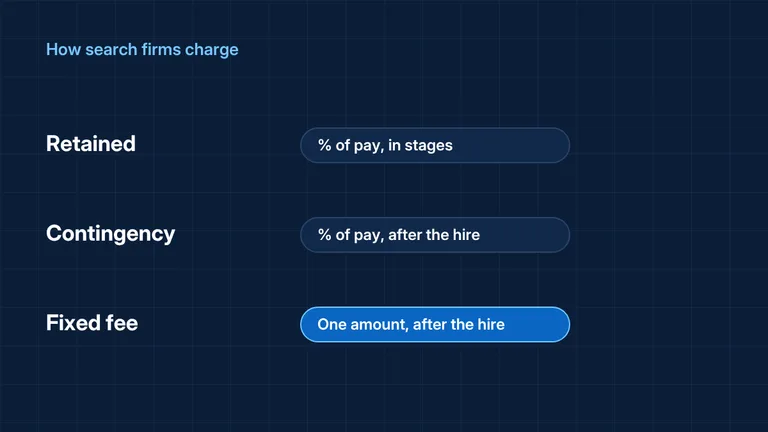
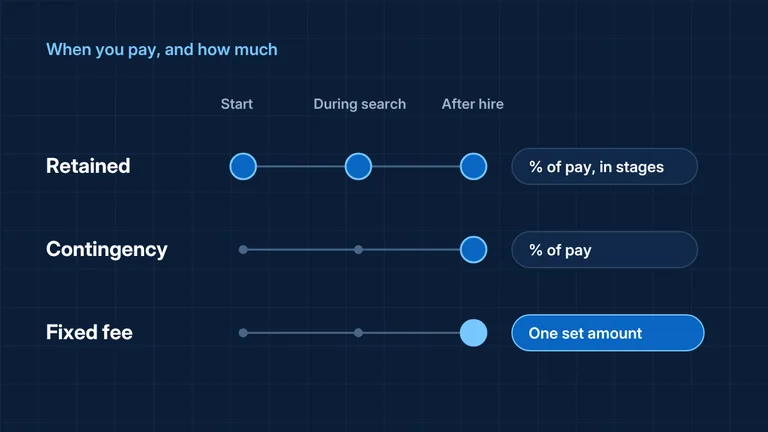
Most agencies charge a percentage of the new hire's first-year pay. With a contingency agency you pay only after the hire. With a retained firm you pay in stages, starting before anyone is hired. Some firms, including us, charge a fixed fee: one amount agreed before the search starts and paid after the hire. Our guide to executive search fees explains each model and the questions to ask, and retained vs contingency search compares the two most common ones.
The fee is the whole cost to you, apart from your managers' time. There is no salary, no tools and no ads to pay in the months between hires.
How to compare the two for your numbers
Do the sum for one year:
- Add up the yearly cost of in-house recruitment: salary, employer costs, tools and ads.
- Estimate how many hires that recruiter would really make in a year, for the roles you actually have.
- Divide the first number by the second. That is your in-house cost per hire.
- Compare it with the fee an agency quoted you for the same kind of role.
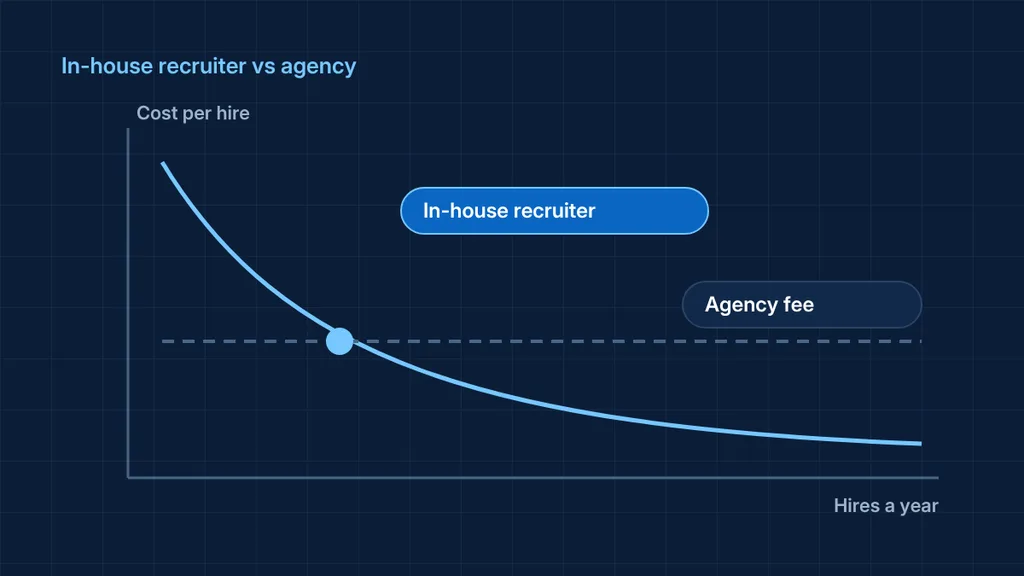
An example with round numbers, not market rates: if in-house recruitment costs you 120,000 a year and makes 12 hires, each hire costs 10,000. If it makes 3 hires, each one costs 40,000. The salary is the same in both cases. The number of hires decides which option is cheaper.
To find the point where both cost the same, divide the yearly in-house cost by the agency fee per hire. The result is your break-even: the number of hires a year at which the two routes cost the same. In the example, in-house at 12 hires a year is cheaper than any agency fee above 10,000 per hire. At 3 hires a year, it is cheaper only when the fee is above 40,000.
So in-house recruitment pays off when you hire often and the roles look alike. A recruiter who fills ten similar roles a year gets faster with each one. A recruiter who fills two very different roles a year costs a lot per hire, and may not know either market well.
What the sum leaves out
- Reach. An in-house recruiter is usually strongest with people who apply and with your own process. For a role where the right people are employed and not looking, someone has to map the market and approach them one by one. That takes time a busy in-house recruiter often does not have.
- The empty seat. While a key role stays open, the work it should do waits. For a role that decides a launch or a quarter, a faster or surer route can cost less overall even with a higher fee.
- A wrong hire. Replacing someone after a few months means paying for the search again, plus the lost time. Ask any agency how it assesses candidates and what happens if the hire leaves early.
- Confidential roles. If the person in the seat does not know yet, your own recruiter cannot always run the search. See confidential recruitment.
Where RPO fits
RPO (recruitment process outsourcing) means an outside firm runs all or part of your recruitment as if it were your own team. You usually pay a monthly fee, sometimes with a fee per hire on top. It suits companies with steady or high hiring volumes that do not want to build a team themselves. For a handful of hires a year, or for one hard role, it is usually more structure than you need.
A smaller version is an embedded or fractional recruiter: one outside recruiter who works inside your team for a few months and is paid monthly or by the hour. It can fit a hiring burst that is too short for a permanent hire.
Which to use when
| How you pay | Best for | Cost in a quiet month | |
|---|---|---|---|
| In-house recruiter | Salary, tools and ads, every month | Regular hiring for similar roles | Full cost |
| Agency | A fee per hire | Occasional roles with active candidates | None |
| RPO | A monthly fee, sometimes plus a fee per hire | Steady or high volumes | The monthly fee |
| Search partner | In stages, after the hire or a fixed fee | Rare, senior or confidential roles | None between searches |
If the right people already apply and your team can assess them, a job ad or your own recruiter may be enough. You do not need an agency or a search firm for every role.
Using both
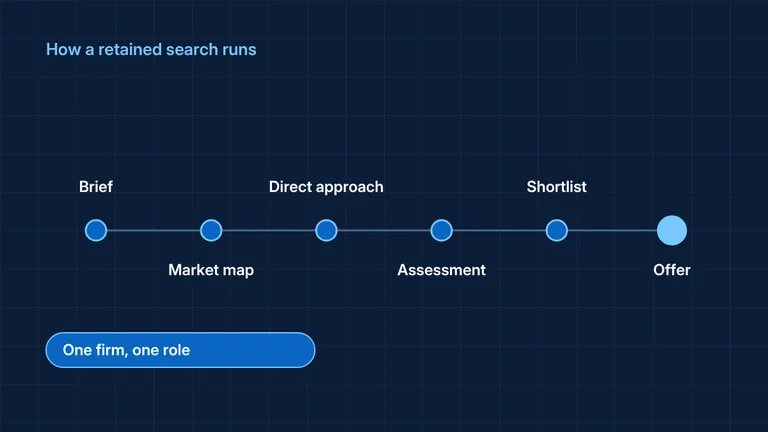
Many companies keep an in-house recruiter for regular hiring and bring in a search partner for the few roles that need a different route. The in-house recruiter stays the owner of the process. The search partner maps the market for one role, approaches people who are not looking and hands over a short list of assessed candidates.
This is how we often work. We run direct searches for specialist and leadership roles for companies in Europe and the US, wherever the role is. Marcin Cieszyński or Renata Chmiel leads the search from the first call: the contract, the search strategy, the assessment and the recommendation. Talent Partners do part of the research, outreach and first screening. At ICEYE we work directly with the in-house recruitment team, on roles such as Government Relations Lead, Marketing Manager and SAR Customer Excellence Expert.
We work exclusively on each role, and our recommended model is a fixed fee agreed before we start and paid after the hire, not a percentage of salary. Fee and guarantee are agreed individually for each project. See how our executive search works.
FAQ
Is an in-house recruiter cheaper than an agency?
Only if they make enough hires. Divide the yearly cost of the recruiter, tools and ads by the hires they make, and compare that with an agency fee for the same roles. With few hires a year, an agency is usually cheaper. The break-even is the yearly in-house cost divided by the agency fee per hire.
When should a company hire its first in-house recruiter?
When you hire regularly through the whole year, the roles look alike and you expect that to continue. If you hire in bursts, or most roles are one of a kind, agencies or a search partner are usually a better fit.
What is the difference between RPO and an agency?
An agency fills single roles and is paid per hire. RPO runs all or part of your recruitment for a period, usually for a monthly fee, and works like your own team.
Can an in-house recruiter and an agency work on the same role?
Yes, if you agree who approaches whom. Share the names you already know, so candidates do not hear about the role twice, and agree that the agency only gets a fee for people it introduced.
Does an in-house recruiter replace executive search?
Usually not for senior or rare roles. Those need a market map and a direct approach to people who are not looking, which takes weeks of focused work on one role.
Not sure which route fits your next hire?
Bring the role, how often you hire and what you pay today. We will say if your own team can do it.
Book a call with Marcin