How to brief a recruiter: a recruitment brief template for employers
In this article
What to prepare before you brief a recruiter or a search firm, the questions a good brief answers, a template you can copy, and what you should get back after the call.
A recruitment brief tells a recruiter why the role exists, what the person must achieve, which experience is a must and which is a trade-off, what you can offer and who decides. A job description lists duties. A brief explains what a good hire looks like and what you will accept instead.
Reading time: about 6 min
Contents
In short
- Send the job description, the offer range and the interview steps before the call.
- Bring the hiring manager to the briefing, not only HR.
- Say what the person must achieve in the first six to twelve months.
- Rank the requirements, so the recruiter knows what you will give up first.
- Ask for the brief back in writing, and correct it before the search starts.
Before the briefing call
The briefing call, also called an intake meeting, works best when the recruiter has read the basics first. Send these a day or two before:
- The job description, even if it is a draft.
- The offer range: base pay, bonus, equity and anything else that matters.
- The interview steps and who takes part in each one.
- The team structure: who the person reports to and who reports to them.
- Any candidates you already know about, so nobody approaches them twice.
Invite the hiring manager. HR can explain the process, but only the person who will manage the new hire can say what good work looks like in this team.
What a good recruitment brief answers
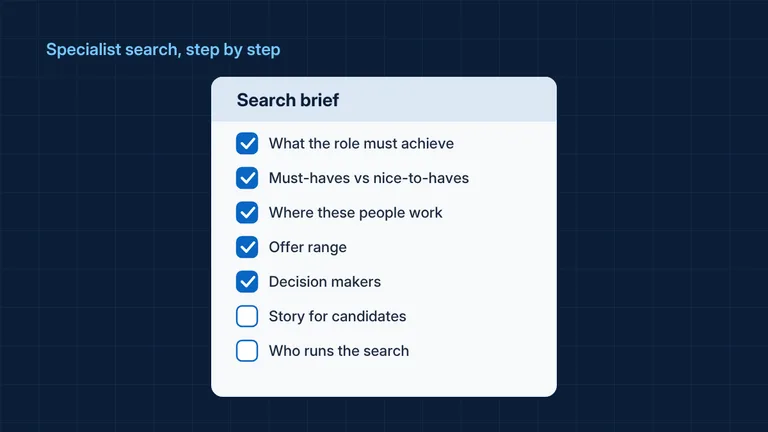
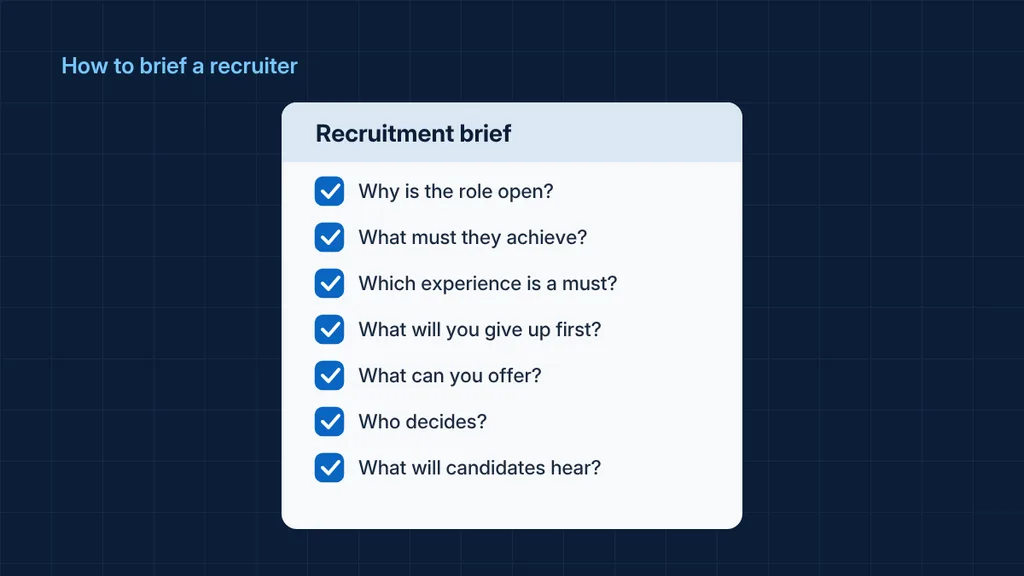
- Why is the role open? A new role, a replacement or a change in the team. If someone left, say why, because candidates will ask.
- What must the person achieve? Two or three results for the first six to twelve months. This is what candidates will be assessed against.
- Which experience is a must, and what would you give up first? Keep the must-have list short. Every extra must-have makes the market smaller. Rank the rest, as the next section shows.
- Where do these people work today? Companies, teams or industries where the right people are likely to be, and any you do not want to approach.
- What can you offer? The range you will really pay, how flexible it is, and where the role is based or how remote it can be.
- Who decides? Everyone who interviews, who has the final say, and how fast you can give feedback.
- What will candidates hear? Why a good person who is not looking would want to talk to you. If the search is confidential, what can be said and when.
Rank the trade-offs
Few candidates meet every point on a list. A recruiter needs to know what you will give up first. A useful way to say it: describe the person who meets everything, then the person you would still hire if one thing is missing, and name that thing.
For example: "Industry experience matters less than having built a team before. We would hire someone from another industry who has hired and led five people. We would not hire someone from our industry who has never managed anyone." Two sentences like these tell the recruiter whom to leave out before anyone is interviewed.
If you cannot rank the requirements yet, say so. It is better to agree them with the recruiter than to start a search the team does not agree on.
Recruitment brief template
Copy these questions into a document and fill them in before the call. Short answers are fine. Some teams call this document a job brief or a hiring brief. In the US the same questions often sit in a recruiter intake form.
| Section | Questions |
|---|---|
| The role | Job title. Why is it open? Who does the person report to? Who reports to them? |
| Results | What must the person achieve in six and in twelve months? How will you know it went well? |
| Must-haves | Three to five at most. What experience, skills or language is required, and why? |
| Trade-offs | What would you give up first? What would you never give up? |
| Market | Where do these people work today? Which companies are off limits? |
| Offer | Base pay range, bonus, equity, location, remote work, start date. |
| Process | Interview steps, who takes part, who decides, how fast you give feedback. |
| Pitch | Why would a good person who is happy in their job want to talk to you? |
| Confidentiality | Can the company be named in the first message? Who inside knows about the search? |
Recruitment brief example
The same template, filled in for an invented role. Your answers can be this short.
| Section | Example answer |
|---|---|
| The role | Head of Customer Support. A new role: the founder has led support so far. Reports to the COO. Six support agents report to the role. |
| Results | In six months: one support process, with reply times measured every week. In twelve months: the team works without the founder. |
| Must-haves | Has led a support team of five or more people. Has set up support for software sold to businesses. Fluent English. |
| Trade-offs | We would give up industry experience first. We would never give up experience of managing people. |
| Market | Software companies with 50 to 300 people. Our two partner companies are off limits. |
| Offer | Base pay range approved by the COO and sent before the call. Bonus tied to team results. Two office days a week. Start within three months. |
| Process | Three steps: the COO, the founder, then the team. The COO decides. Feedback within two working days. |
| Pitch | You build the support function from the start, in a company where the founder still answers customers. |
| Confidentiality | The company can be named in the first message. The support team knows about the search. |
If you are hiring a specialist in Poland, our brief checklist for Poland also covers the contract type (employment contract or B2B) and where specialist profiles are concentrated.
What you should get back
After the call, a good recruiter sends the brief back in writing: the results, the must-haves, the trade-offs, the offer and the process, in their own words. Read it with the hiring manager and correct anything that is wrong, because a misunderstanding costs least to fix before the search starts.
For a search where the right people are not applying, you should also hear how the recruiter plans to find them: which companies and roles they will look at, and roughly how many people fit. If the market looks too small for your must-haves, they should say so now, not after a month of searching.
Signs the brief needs another look
- The first candidates are rejected for a reason that was not in the brief.
- Different interviewers reject the same candidate for opposite reasons.
- Candidates drop out when they hear the offer.
- Good people are not interested once they hear about the role.
Each of these points to something the brief did not say clearly. Stop, agree the change with the recruiter and update the written brief before the next round.
How we run the brief
At Talentholo, Marcin Cieszyński or Renata Chmiel agrees the brief and the contract with you, sets the search strategy, assesses candidates and makes the recommendation. The brief is the first step of every search: a call in which we agree what the person must achieve, the experience that matters, the offer range and who makes the decision. Talent Partners do part of the research, outreach and first screening, working to that brief. We run direct searches for specialist and leadership roles for companies in Europe and the US, wherever the role is.
What you see before you sign
We try to show you as much as we can before you sign anything, so you know what the market looks like and how the search would run. After the briefing call we send the brief back in writing, so you can correct it before any work starts.
We also tell you roughly how large the group of people who fit is: whether there are many of them, few, or almost none for the brief as it stands. Often we can go further and prepare a first long list of candidates, so you can see the kind of people we would approach.
In some searches we run what we call a live or calibration search. We show you a few real profiles early on, and you tell us which ones are close and which are not. It does not fit every role, but when it does, it shows quickly whether the brief and the market match. If something in the brief will be hard to find, we say so at the start.
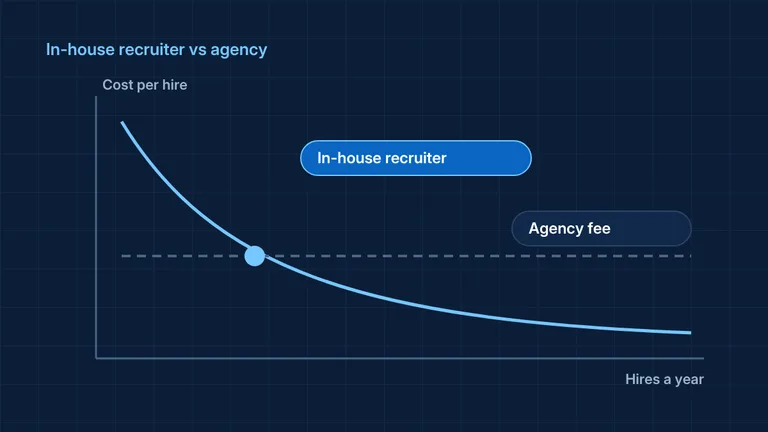
If the right people already apply and your team can assess them, a job ad or your own recruiter may be enough. We will say so on the first call. See how our executive search works, or read how to choose an executive search firm before you brief anyone.
FAQ
What is a recruitment brief?
A short document that tells a recruiter why a role is open, what the new person must achieve, which experience is required, what you can offer and who decides. It is agreed before the search starts and used to assess every candidate.
Is a job description the same as a brief?
No. A job description lists duties and requirements for candidates. A brief is for the recruiter. It adds the reasons, the trade-offs, the real offer range and the decision process.
Who should attend the briefing call?
The hiring manager, the recruiter, and the person from HR or talent acquisition who runs the process. For a senior role, also the person who makes the final decision.
How long should a briefing call take?
Usually under an hour if you send the basics first. A senior or confidential role may need a second, shorter call once the recruiter has looked at the market.
What is an intake meeting in recruitment?
Another name for the briefing call. The recruiter and the hiring manager agree the role, the requirements, the offer and the process before the search starts.
What is a calibration search?
A short first round of a search in which the recruiter shows you a few real candidate profiles and you say which are close to what you need. It checks that the brief and the market match before the full search runs.
Have a role to brief?
Bring the job description, the offer range and what the person must achieve. We will tell you what is realistic, and we will say so if we are not the right fit.
Book a call with Marcin